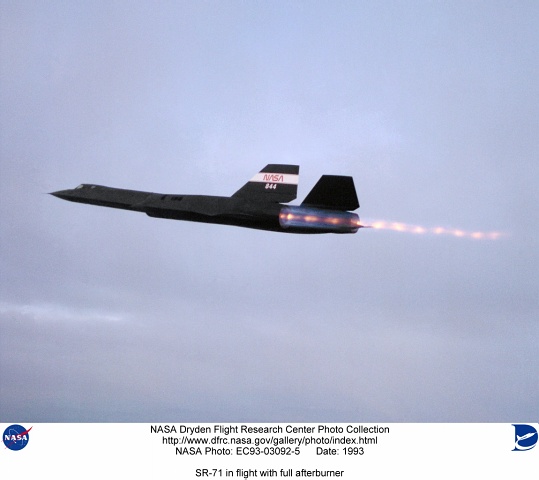
NASA’s SR-71 streaks into the twilight with full afterburner on the first night/science flight from the Dryden Flight Research Facility, Mar. 9, 1993. Onboard were research pilot Steve Ishmael and flight engineer Marta Bohn-Meyer. Mounted in the nose of the SR-71 was an ultraviolet video camera aimed skyward to capture images of stars, asteroids and comets. This flight checked the operation of the camera to insure the air turbulence at Mach speeds and the vibration of the aircraft did not interfere with the operation of the camera. The science portion of the flight is a project of the Jet Propulsion Laboratory, Pasadena, California.
<HTML>
<HEAD>
<STYLE Type="text/css">
< /FONT>
BODY {margin:
.75in; font: 12pt "Century Schoolbook", "Times New Roman", serif}
H1 {font:
20pt "Arial", "Gill Sans", sans-serif; font-style: italic; font-weight: bold}
IMG {border: black solid thin;
marigin-right: 24pt; float: left}
</STYLE> </HEAD>
<BODY>
<IMG
SRC="../../../images/SR71-inflight.jpg" width=280 height=270 ALT="SR71
inflight">< /FONT>
<P> NASA’s SR-71 streaks into the twilight
with full afterburner on the first night/science flight from the Dryden Flight
Research Facility, Mar. 9, 1993. Onboard were research pilot Steve Ishmael and
flight engineer Marta Bohn-Meyer. Mounted in the nose of the SR-71 was an
ultraviolet video camera aimed skyward to capture images of stars, asteroids and
comets. This flight checked the operation of the camera to insure the air
turbulence at Mach speeds and the vibration of the aircraft did not interfere
with the operation of the camera. The science portion of the flight is a project
of the Jet Propulsion Laboratory, Pasadena, California.</P>
</BODY>
</HTML>